Emilia Schmitt
PhD, Senior Researcher

Discover all the publications related to the True Cost of Food Project
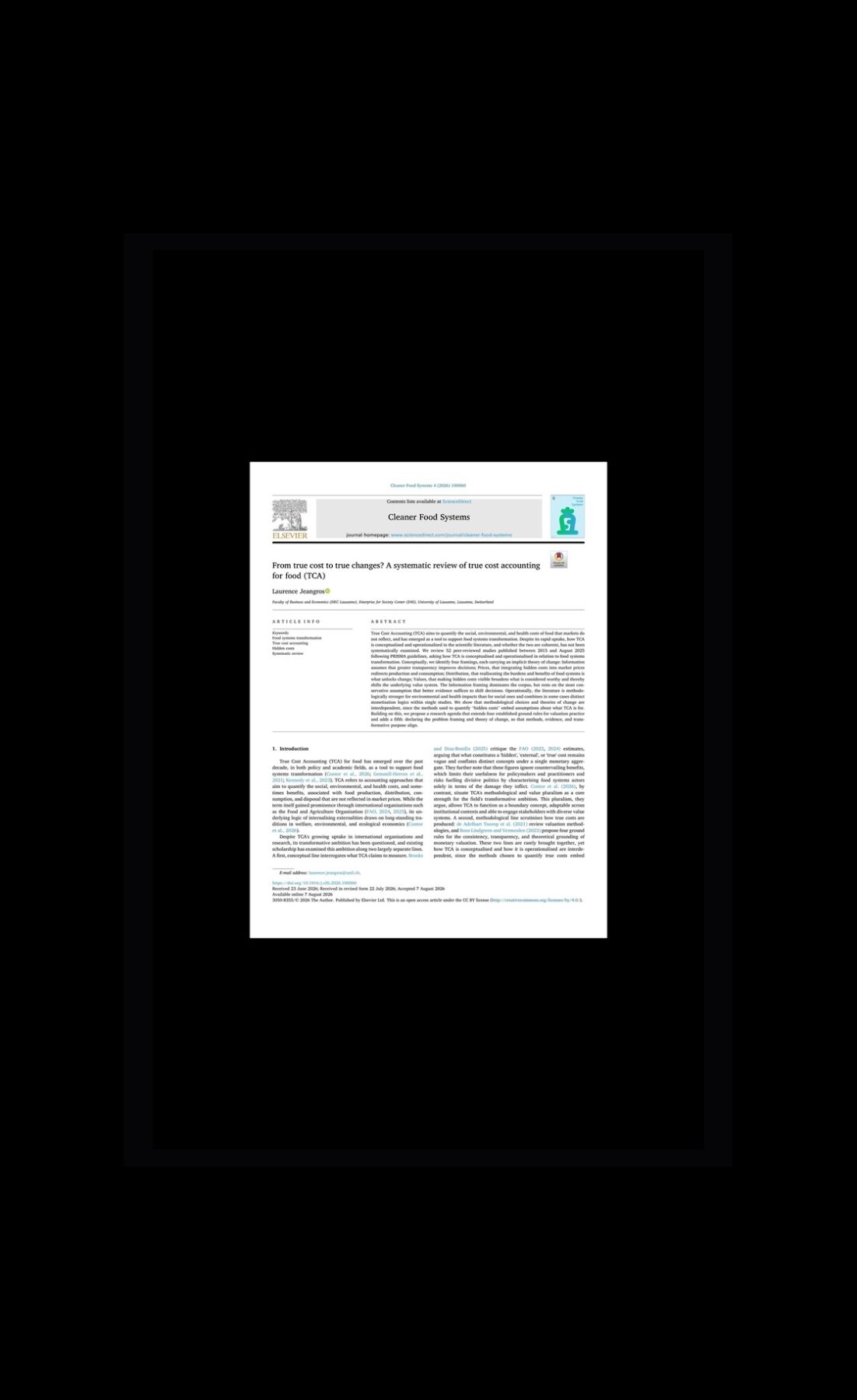
Purpose of the Review. This review examines how True Cost Accounting (TCA) is conceptualised and operationalised in the scientific literature in relation to food systems transformation. Based on a review of 52 peer-reviewed studies published between 2015 and August 2025, following PRISMA guidelines, it investigates how TCA is framed, applied, and linked to theories of change. Recent Findings. Four conceptual framings of TCA emerge from the literature. The Information framing assumes that increased transparency improves decision-making; Prices suggests that integrating hidden costs into market prices redirects production and consumption patterns; Distribution focuses on reallocating the burdens and benefits generated by food systems; and Values argues that making hidden costs visible broadens societal understanding of what should be valued. While the Information framing dominates the literature, methodological approaches are generally more robust for environmental and health impacts than for social impacts, and some studies combine distinct monetisation approaches within a single assessment. Summary. The review demonstrates that methodological choices and theories of change are closely interconnected, as the methods used to quantify hidden costs implicitly reflect assumptions about the purpose of TCA. Building on these findings, the authors propose a research agenda that extends four established ground rules for valuation practice and introduces a fifth principle: explicitly declaring the underlying problem framing and theory of change to ensure alignment between methods, evidence, and transformative objectives.Abstract
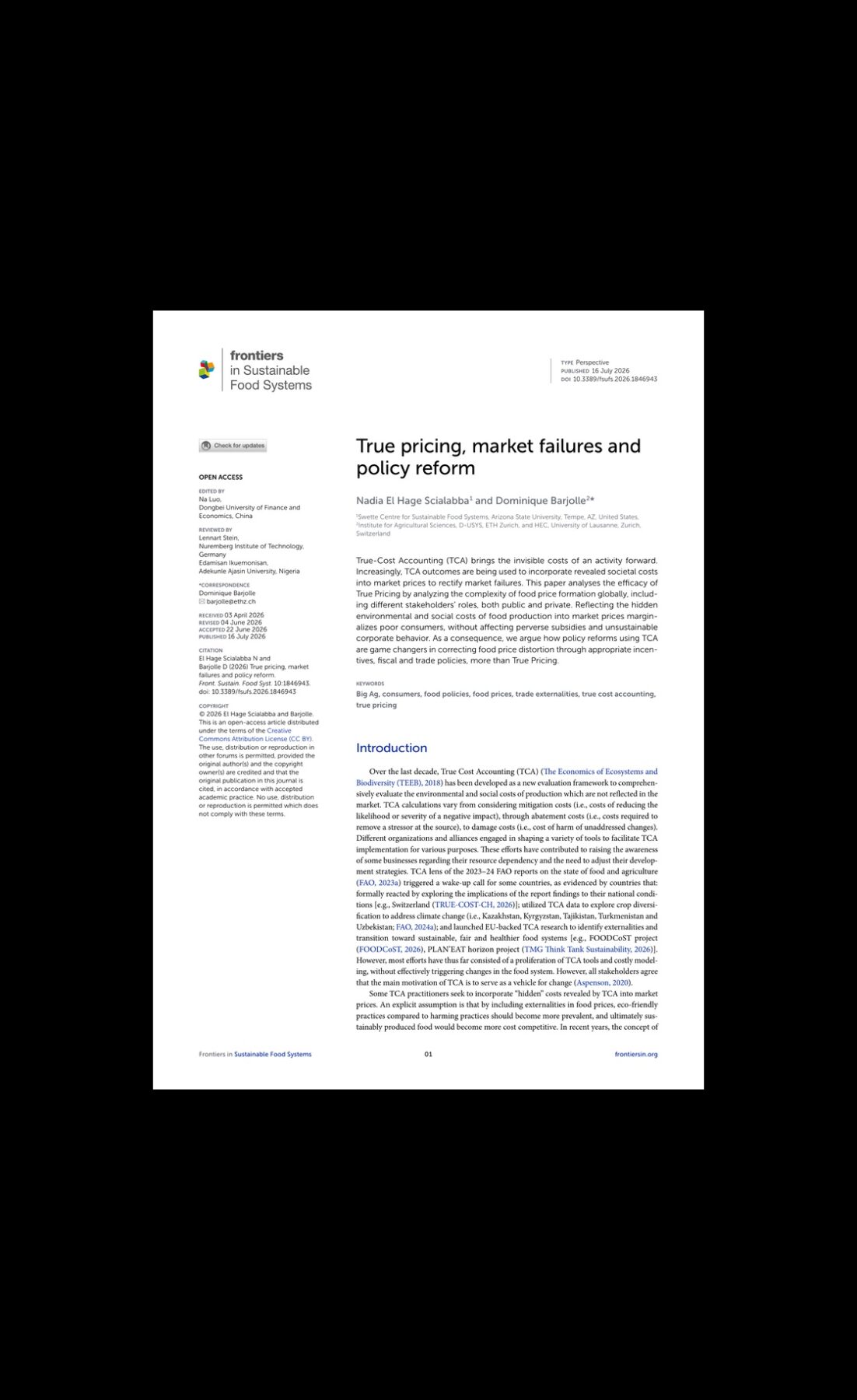
Purpose of the Study. This article examines the effectiveness of True Pricing as a mechanism for integrating the environmental and social externalities of food production into market prices. It explores the complexity of food price formation and the roles played by public and private stakeholders across global food systems.
Key Findings. While True-Cost Accounting (TCA) makes previously hidden societal costs visible, transferring these costs directly into food prices may disproportionately affect low-income consumers. At the same time, such price adjustments do little to address market distortions caused by harmful subsidies, market concentration, and unsustainable corporate practices.
Conclusion. The findings suggest that policy reforms informed by TCA are more effective than True Pricing alone in correcting food price distortions. Appropriate fiscal measures, incentive schemes, trade policies, and the reform of perverse subsidies have greater potential to deliver equitable and sustainable food systems while addressing environmental and social externalities.
Read the paper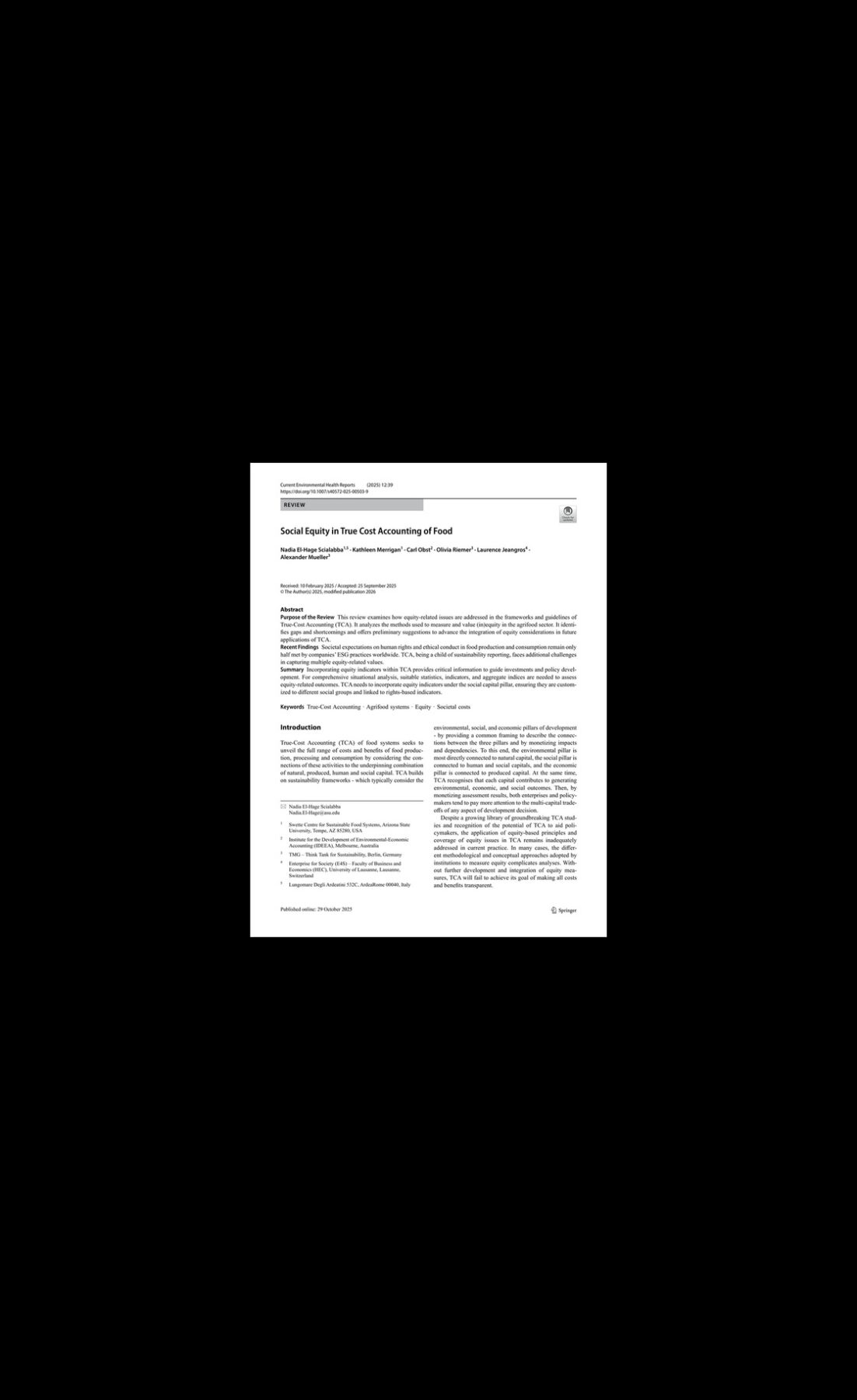
Purpose of the Review. This review examines how equity-related issues are addressed in the frameworks and guidelines of True-Cost Accounting (TCA). It analyzes the methods used to measure and value (in)equity in the agrifood sector. It identifies gaps and shortcomings and offers preliminary suggestions to advance the integration of equity considerations in future applications of TCA. Recent Findings. Societal expectations on human rights and ethical conduct in food production and consumption remain only half met by companies’ ESG practices worldwide. TCA, being a child of sustainability reporting, faces additional challenges in capturing multiple equity-related values. Summary. Incorporating equity indicators within TCA provides critical information to guide investments and policy development. For comprehensive situational analysis, suitable statistics, indicators, and aggregate indices are needed to assess equity-related outcomes. TCA needs to incorporate equity indicators under the social capital pillar, ensuring they are customized to different social groups and linked to rights-based indicators. Abstract
Purpose of the Review. This review examines how equity-related issues are addressed in the frameworks and guidelines of True-Cost Accounting (TCA). It analyzes the methods used to measure and value (in)equity in the agrifood sector. It identifies gaps and shortcomings and offers preliminary suggestions to advance the integration of equity considerations in future applications of TCA. Recent Findings. Societal expectations on human rights and ethical conduct in food production and consumption remain only half met by companies’ ESG practices worldwide. TCA, being a child of sustainability reporting, faces additional challenges in capturing multiple equity-related values. Summary. Incorporating equity indicators within TCA provides critical information to guide investments and policy development. For comprehensive situational analysis, suitable statistics, indicators, and aggregate indices are needed to assess equity-related outcomes. TCA needs to incorporate equity indicators under the social capital pillar, ensuring they are customized to different social groups and linked to rights-based indicators. Abstract
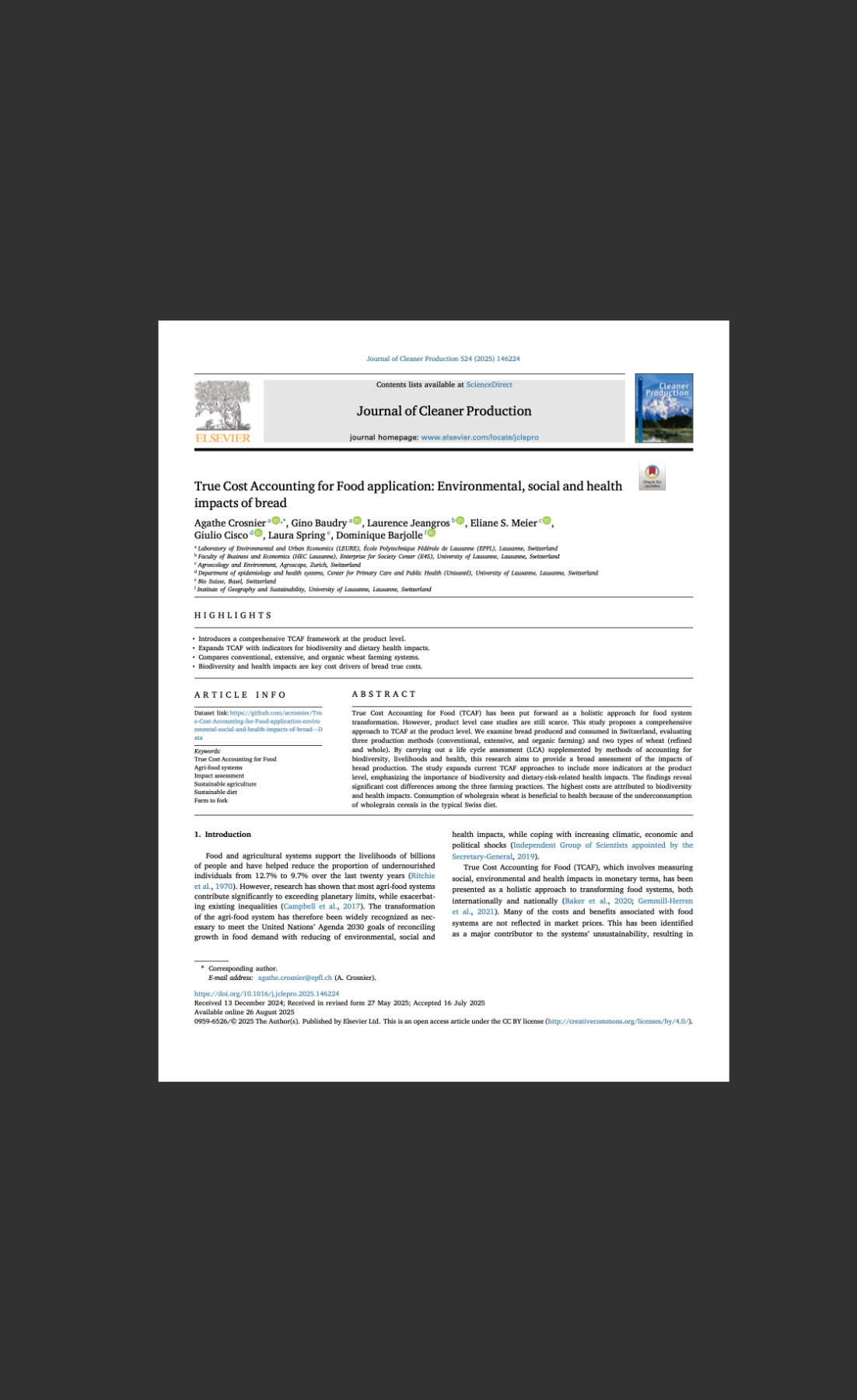
True Cost Accounting for Food (TCAF) has been put forward as a holistic approach for food system transformation. However, product level case studies are still scarce. This study proposes a comprehensive approach to TCAF at the product level. We examine bread produced and consumed in Switzerland, evaluating three production methods (conventional, extensive, and organic farming) and two types of wheat (refined and whole). By carrying out a life cycle assessment (LCA) supplemented by methods of accounting for biodiversity, livelihoods and health, this research aims to provide a broad assessment of the impacts of bread production. The study expands current TCAF approaches to include more indicators at the product level, emphasizing the importance of biodiversity and dietary-risk-related health impacts. The findings reveal significant cost differences among the three farming practices. The highest costs are attributed to biodiversity and health impacts. Consumption of wholegrain wheat is beneficial to health because of the underconsumption of wholegrain cereals in the typical Swiss diet. Abstract
The true cost accounting for food (TCAF) methodology was developed to quantify the environmental, social and health externalities associated with food systems, from production to consumption. One possible implementation consists of changing the current prices on the supermarket shelves to reflect the true prices (i.e. adding the true costs to market prices), incentivizing a transition to more sustainable food systems. Understanding the knowledge and attitudes of consumers towards TCAF is key to informing potential implementation, as attitudes exert influence on behaviour. In this context, this study analysed the determinants of a positive attitude towards TCAF in Switzerland. An online survey was conducted in Switzerland in June 2024 and included questions on the true cost approach, true price, general food choice motives and sociodemographic characteristics. Data from 224 respondents were analysed. Results indicated low previous knowledge of TCAF among Swiss residents. However, after providing some information on the approach, respondents showed a positive attitude towards TCAF and true price implementation to reduce health, environmental and social externalities. Results from regression analysis suggest that trust in TCAF and true price methodologies strongly influenced the positive attitudes towards TCAF. The sense of environmental protection was also associated with a positive attitude. Moreover, participants with more positive attitudes towards TCAF tend to give more importance to paying for the externalities of food compared to affordability issues. This study is a first step to better understand the acceptability and feasibility of implementing TCAF and true price in Switzerland, from consumers’ point of view. Actors along the food value chain can use this information to support the transition towards more sustainable food systems. Abstract
Introduction. The implementation of “farm to fork” solutions, taking into account the entire food value chain, is necessary to address the wide range of issues arising from agri-food systems. On the production side, organic farming is one of the main alternatives proposed. However, the interactions between the expansion of organic agriculture and the generalization of dietary changes according to dietary guidelines at the country level have not yet been considered. Methods. This paper presents a commodity-based modeling of Swiss domestic food production in 2050, derived in four scenarios to compare the environmental impacts of organic and business-as-usual production as well as of two dietary guidelines, namely the EAT-Lancet and the Swiss Food Pyramid. A Life Cycle Assessment approach is then used to assess the environmental impacts through climate, ecosystems, soil and resource depletion. Results. All scenarios showed lower impacts compared to the current situation projected for 2050, mainly due to dietary changes. Despite lower yields, 100% organic production remains feasible if combined with dietary changes. Organic farming can be more impactful than conventional farming. Discussion. The results highlight that the implementation of the best diet and alternative production method may trigger unforeseen interactions and emphasize the need for a systemic approach. Abstract